02 May 2022

clipping files

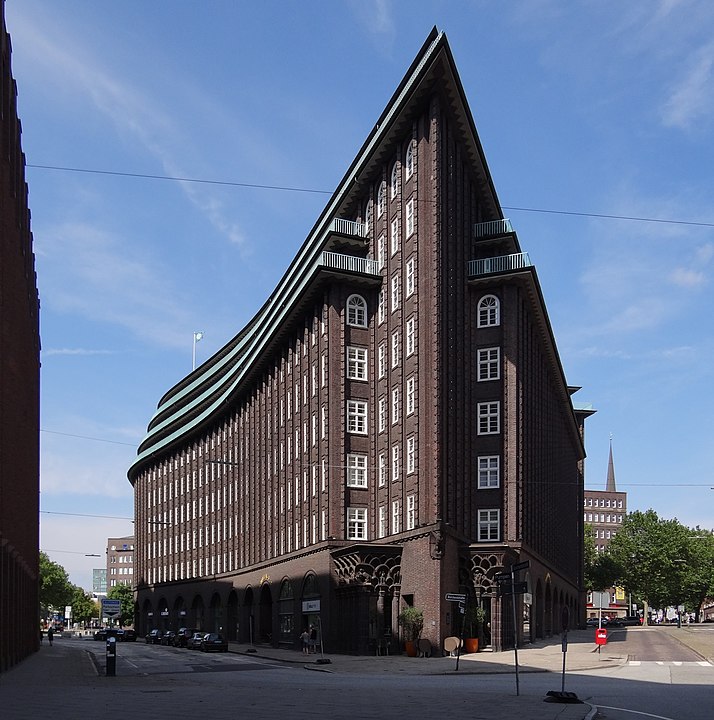
Every month, Architectural Record runs a "Guess the Architect" contest. The May issue came in today's mail and the building looked familiar but I couldn't place it. The architect was identified as being known for his interest in brick and the building's shape alludes to its location in a harbor city and its ownership by a shipping company. I googled around with various things and finally put in "hamburg" as a fairly wild guess, and there it was.

By Esther Westerveld from Haarlemmermeer, Nederland - Chilehaus - Hamburg, CC BY 2.0, https://commons.wikimedia.org/w/index.php?curid=33420849

The Chilehaus was completed in 1924 and designed by Fritz Höger. His Wikipedia page is linked under his name. One of the sources of information is the newspaper clipping files in the 20th Century Press Archives at the ZBW, aka the German National Library of Economics. The clippings are digitized and easily zoom in and out. We've had lots of sessions and discussions about artist files in ARLIS/NA circles. We finally got Artist files into the LC controlled vocabularies, specifically LCGFT.

The artist files were a very important part of our library resources when I worked at the Amon Carter Museum, Fort Worth, in the early 1990s.

By the way, when you look at the Chilehaus in context with the assistance of the little yellow guy in Google, the prow of the building is considerably less pronounced.

Bonus picture, aerial view of Chilehaus:

By Foto: Martina Nolte, Lizenz: Creative Commons by-sa-3.0 de, CC BY-SA 3.0 de, https://commons.wikimedia.org/w/index.php?curid=26568634

16 April 2022

Hieronymus Bosch in the NYTBR

Twice during the past couple-three weeks in the New York times book review, writers have mentioned Hieronymus Bosch.

"'The Doloriad' evokes Beckett's plays, or, in its static depiction of misery, Hieronymus Bosch's paintings. But 'Endgame' and 'The Garden of Earthly Delights' are funny and don't take five hours to get through. Ultimately this book, for all its ambition, isn't for me. But, who knows, it just might be what your rotten little heart deserves." -- J. Robert Lennon, in a review entitled "Wicked by design" of The Doloriad, by Missouri Williams, MCD/Farrar, Straus & Giroux, New York times book review, March 27, 2022, p. 10.

"One of my treasures is a book received long ago from fellow students as a present for my Ph. D. It is a beautifully illustrated volume about Hieronymus Bosch, the medieval painter. Many people find his art disturbing, but I was born in the city where he lived and worked, and grew up with his imaginative visions of heaven and hell. I like his attention to facial expressions while depicting humanity's sins and follies. There are also tons of animals in his paintings mixed with trees, fruits and figures that are half human, half animal. Bosch was the world's first surrealist." -- Frans de Waal, "By the book," New York times book review, April 3, 2022, p. 6.

I wonder if Frans de Waal's "beautifully illustrated volume" is the 1966 monograph on Bosch by Charles de Tolnay that has had a place of honor on my shelves for more than 50 years. I am much more taken by de Waal's image of Bosch than Lennon's "static depiction of misery." Flying to Madrid to see Bosch's paintings may take more than five hours but it is well worth the trip.

11 April 2022

restraint is relative

When you see a lovely rowhouse like this one in the 1300 block on North Dearborn Street in Chicago, you think about the extravagant window surrounds and variations in material colors. "Restraint" is not the first word that comes to mind, especially given the other houses nearby.

And then your mind drifts to those art nouveau houses you saw in Brussels:


Or to the multicolor exteriors of art nouveau houses in Turin:

Why, that Chicago house is almost classical in its quiet eclecticism.

03 April 2022

separated at birth: basalt churches

Mount Vernon Place United Methodist Church
Baltimore, Maryland
(Thomas Dixon, archt., completed 1872)
Gothic Revival

Santa Maria
Randazzo, Sicily, Italy
(opened 1214, belltower completed in 1863)
Gothic / Gothic Revival

08 March 2022

I brake for chipmunks

This morning on my morning walk, I noticed a chipmunk was crossing the street about fifteen feet ahead of me. I stopped walking, just about as the chipmunk stopped moving. It seemed to be listening to see if those approaching footsteps were dangerous. It turned around, ran back in the direction it had come, and went almost up to the pine trees and stopped again. I didn't move. It reassessed the danger. Turned around again and ran across the street when it determined the footsteps were no longer approaching.

When I lived in Texas, I had a bumper sticker on my Isuzu pickup that said "I brake for Greek Revival." I think it came from the preservation society in Providence because Texans don't have quite so much Greek Revival as they have in Rhode Island. Bob drove the truck to work one day and one of his coworkers thought it said "I brake for Geek Revival." Not the same thing.

P.S. because it's a small world. I was looking for a picture of a chipmunk running across the street and one of the Google responses was from Dickinson, North Dakota, the destination of the road trip in Breakfast with Buddha.

04 March 2022

The Modern, Fort Worth

This fine building, housing the Fort Worth Community Arts Center, was across the street from the Amon Carter Museum when I worked there. The building then housed the Modern Art Museum of Fort Worth which later moved to a Tadao Ando building not far away. This building was designed by O'Neil Ford & Associates and is connected to the Scott Theater designed by Herbert Bayer.

Today I got to try to disentangle the authority record for Arts Fort Worth which is the new name of the merged Fort Worth Community Arts Center and the Arts Council of Fort Worth. But, more importantly, I got to think about this wonderful building.

Now the Modern looks more like this.

I was quite disappointed when I first visited Fort Worth after this building was open. I approached it from Allen's house and what you were greeted by was the loading dock. Not very pedestrian friendly. It is Sunbelt U.S. of A. Oh, well, you also get loading dock when you approach the Art Institute of Chicago from Monroe Street, a little more disguised.

01 March 2022

separated at birth: Sicilian mecca


Selinunte,

on the southern coast of Sicily,

picture taken in March 2013


Mecca Hills Wilderness, California,

picture taken by DAS in February 2022


25 February 2022

North Dakota redux

Today, still in North Dakota:

Oxford House, Fargo, N.D., built 1902 for Webster Merrifield, the third president of the University of North Dakota. Served as the president's house until the 1950s and then became a dormitory, the art department building, and the alumni center, before sitting mostly unused after 2012. Now rehabilitated as the Dr. Kathleen and Hal Gershman Graduate Center. Rehabilitation architects: JLG Architects (who also are working on the Theodore Roosevelt Presidential Library). Photo by Chad Ziemendorf for Preservation, the National Trust magazine. Oh, by the way, yes, this did come to my attention as I indexed.

24 February 2022

North Dakota

What are the chances that North Dakota will come at you two days in a row? Perhaps not high, but also not impossible, as I discovered earlier today.

Yesterday, a friend from New York City sent us a link from a Hyperallergic article about a protest over the plan to send the controversial statue of Teddy Roosevelt from the front of the American Museum of Natural History in NYC to the forthcoming Theodore Roosevelt Presidential Library. The site for the library is on seized Indigenous land in North Dakota.

After reading the Hyperallergic article, I crawled into a prairie dog hole on the TRPL website. The building site is near Medora, N.D., and TR's ranch and the Theodore Roosevelt National Park, Much of that land was seized in the Treaty of Fort Laramie (1851). Rather like all of the other Indigenous land in North America that was bought, stolen, or seized from the Native Americans.

The book I am currently reading is Breakfast with Buddha by Roland Merullo (2007). It was recommended by Dorothy when I mentioned that I had really enjoyed his The delight of being ordinary, about a road trip by Pope Francis and the Dalai Lama. Breakfast with Buddha is also about a road trip, about Otto Ringling who drives to North Dakota to empty his childhood home after his parents are killed in a traffic accident. He was supposed to take his wacky sister but she substitutes a somewhat inscrutable Rinpoche. An "inscrutable Rinpoche" may be inherently redundant.

While the Rinpoche is meditating before they set off for a day's journey, Otto sinks into a couple hours of morning television at their hotel. As he's speculating about the sordid and exposed lives of the guests on the talk show, he remembers what his father said about North Dakota as the family returned from a sun festival at one of the Indian reservations in North Dakota.

"After we'd watched the dancing and singing and were on our way home in our car, my dad remarked upon how far we'd advanced since the days when the land was ruled by Indian tribes. There were farms now, he said, where once there'd been only buffalo. Farms with telephones and TVs, tractors, airplanes, medicines ... whereas, in those old days there had been nothing. You worked from morning till night, you hunted and fished and sewed and cooked, sang and danced a few times a year, made war, made peace. 'Look at us now,' he said, sweeping his hand out near the windshield at a stretch of heartland. 'Look at all this.'" (page 137, ellipsis in the book) The protagonist compares this "nothing" or "all this" to the wasteland of the TV talk shows that he had just wallowed in for a couple hours.

By the way, North Dakota is one of the three U.S. states that I have never set foot in. And reading Buildings of North Dakota was the impetus for one of my first edits of a Wikipedia page when I noted a church by an architect who also did a church in Napoleon, Ohio.

Also, by the way, just a few pages beyond the protagonist's family trip memory in Breakfast with Buddha is a chapter that circles around coincidence.
14 February 2022

separated at birth: index / indexing

I was looking at the Times book announcements and reviews yesterday. One of the reviews was of Index, A history of the: a bookish adventure from medieval manuscripts to the digital age by Dennis Duncan (W.W. Norton). Just my kind of book. I love my indexing gig and the book is about books (&c) and the title is inverted like a subject heading string might be. It's got a pretty zippy cover.

When I think of indexes aesthetically, I generally wander over to the work of Alejandro Cesarco who was often on exhibit at Murray Guy, a favorite gallery on West 17th Street. He has done these wonderful pages of index entries where the indicated mentions may be interlocked though many stand alone. He has also done other book-related art and was matched with John Baldessari in the Rolex Mentor & Protégé Arts Initiative. 
You can see more of Cesarco's work on his web page, linked under his name.