Showing posts with label Italy. Show all posts

06 June 2025

Milan: changing skyline

When we were in Milan in spring 2018 and stayed near the Bosco Verticale, this was the view toward the Porta Nuova development.

Last week when I was indexing the May 2025 issue of Architectural Record with its Building Type Study of tall buildings, one of the featured buildings was the new Unipol Tower designed by Mario Cucinella Architects.


26 April 2025

Francis, pope 2013-2025

I've been watching some videos of the procession of the coffin of Pope Francis through the streets of Rome, from the Vatican where the funeral was held to Santa Maria Maggiore where he will be interred.
The NBC reporter on the street near the beginning of the procession was talking to some Americans who happen to be in Rome for a photography workshop. One mentioned what an honor it has been to be in Rome at a special moment. (The picture is a screen grab of the statues on the top of the facade of Santa Maria Maggiore.)

Francis has been special to me too, for personal reasons. We happened to be in Sicily when he was selected as pope in 2013. We had found a parking place and I went to call a B&B that looked promising. It was a few blocks from where we parked in the middle of Noto. Christie stayed in the car with her iPad, watching the papal news and studying the map and listings. It took most of an hour to call the B&B host who wasn't at home, walk to the B&B to meet him there, look at the room, accept it, and walk back to the car. The news of "Habemus Papam" (we have a pope) happened during that hour.

We moved the car closer to the B&B and watched some television in the room and in a nearby restaurant where we went for supper. We liked the location well enough to stay for three nights, using it as a hub for day trips to Siracusa and the southeastern corner of Sicily. 

23 March 2025

in the mood for travel

Daniel said he was hoping that Americans would still be welcome when he traveled outside the United States, adding that he could always say he was a New Yorker. That reminded me that I was once rewarded with a hug and a kiss on each cheek in Modena, Italy, when I said I was from New York City.

Christie and I were traveling around Emilia-Romagna in October 2001, just a month or so after the attack on the World Trade Center. On our first night, we found a hotel in Modena and went out for drinks and then to supper.

We were somewhat jet-lagged and tired. The woman at the hotel had noted a few nearby eating places of varying character and none caught our fancy as we walked past them. We got to a small square and noticed a welcoming restaurant across the square. The owner was just writing the supper menu on the blackboard and we talked to her, in a mix of English and Italian and facial and hand expression, about what was on offer that evening. After we'd determined that we were really ready to eat there, she said she was Italian and was from Modena. She said you're American and you are from where? When I said "New York," she said "Il principe" (the prince) and gave me a hug and kisses.

The supper was extraordinary. We ended up chatting with a couple Italians who sat at a small table next to ours. We ended up staying until the restaurant closed and then we four went to a coffee bar and closed it down too.

I had another 9-11 experience on that trip. I was walking around San Domenico in Bologna. There weren't too many other people in the plaza and an airplane flew over. Not particularly low in the sky but a reminder of the airplanes flying into the Trade Center. Gave me a start.

On another trip to Italy, we were looking for a lunch place in Buccheri on Sicily. I went over to the prominent restaurant on the central square that said it was open but no one was around to ask about a table. When I got back to the car and reported that to Christie, she said that lots of people seemed to be coming and going from the Caffè Roma nearby. We checked it out and had a delightful lunch. The lesson I learned is that a bit of patience and observation can be a good travel guide.

08 February 2025

the shape of the plaza and the distant view

So I was watching episode two of One Day and enjoying the sights of Rome. When Dexter is talking to his mother outside her hotel, the space in front of the hotel was so familiar. Not just the narrow space there, opening into the wider plaza beyond. The decorated façade of the shopfront across from the hotel. It just had to be the Rome hotel that Carol and I stayed in before we went to Florence for the IFLA art periodicals conference in 1986. Dexter's father comes to the door to meet them. The sliding door has the name "Campo de' Fiori" painted on it. That's it, our hotel.

That was my first time in Rome. I was excited beyond words. Carol had gotten there a while before I did. I had been warned not to take anything but a legitimate taxi from the central train station. My cab was somewhere near the taxi stand but he drove me a very indirect route to the Campo area. I had a map and was able to follow where we were. He was having trouble finding the Campo and stopped at a business on a very narrow street to ask directions. We got close, to the nearby Piazza Farnese which is in front of the French Embassy. I told him this was close enough, paid him, and got out of the car to get my suitcase from the back. He took off. I ran after him and he went out into the clogged traffic on the Lungotevere, along the Tiber River. As I ran, I was shouting something and a guard at the embassy joined the chase. (Was this a movie?) Anyway, the guard stood on the corner and I pointed to the supposed taxi. With a uniformed security man standing there, the driver got out and opened the back of the car so I could get my suitcase. I walked sheepishly the block and a half to the Hotel Campo de' Fiori. By the time we left Rome a few days later, I knew how to take the city bus from near the Campo to the central station.


09 December 2024

writing in space

Sometimes my indexing or cataloging takes me to places I really want to go or where I have very happily been. Sometimes it's a bit of both. I really enjoyed my trips to Milan in 2018, including a climb up to the roof of the Duomo. Hanging out with the gargoyles. My indexing a day or two ago included an article about eL Seed in Abitare. His work usually includes some Arabic calligraphy and the work above was on the plaza in front of the Duomo in Milan. He is Franco-Tunisian so I assumed his nom d'art was derived from something like al-Said. But no. One of the bits of biography that I found on the web described his love of El Cid as a child and his appropriation and respelling of that name.
I often check the Library of Congress Name Authority File when I encounter a new person and want to see if their record looks ok. I was amused to note that the record for eL Seed was done at the Metropolitan Museum of Art so I sent them a note of gratitude. William claimed it.

Thanks, William, and thank you, Bassam Makansi on Facebook, for the good picture of the calligraphy on the plaza. The picture from the roof of the Duomo is mine from 2018.

21 February 2024

04 June 2022

memories of my grandmother, inspired by Armistead Maupin

Armistead Maupin (Teddy, to his family) visited his grandmother at the nursing home and she did not recognize him. The long-past occurrence of reading his palm triggers her memory.

"I was making a gloomy retreat from Grannie's apartment when I had an idea. Returning to her chair, I thrust out my hand with the palm turned upward for her perusal. She seized it immediately and began reading the lines in rapt silence, like a book she'd laid down the night before and couldn't wait to return to.

Then, without even looking up, she said, very softly, 'Teddy.'

'Yes,' I said, laughing. 'Yes!'

'You're in your thirties now.'

'I am indeed.'

When her eyes finally moved up to my own, they were as open and lively as the sea. 'And you've written a novel, you say?'

'Yes. And you're in it.'

'Oh, dear.'

I laughed again. 'Not literally, but your spirit is there. Your loving, accepting spirit. She's a landlady in San Francisco, and she's a little ... spooky about things.'" [ellipsis in the text]

--Logical family: a memoir by Armistead Maupin (HarperCollins), page 276-277 in the paperback edition.

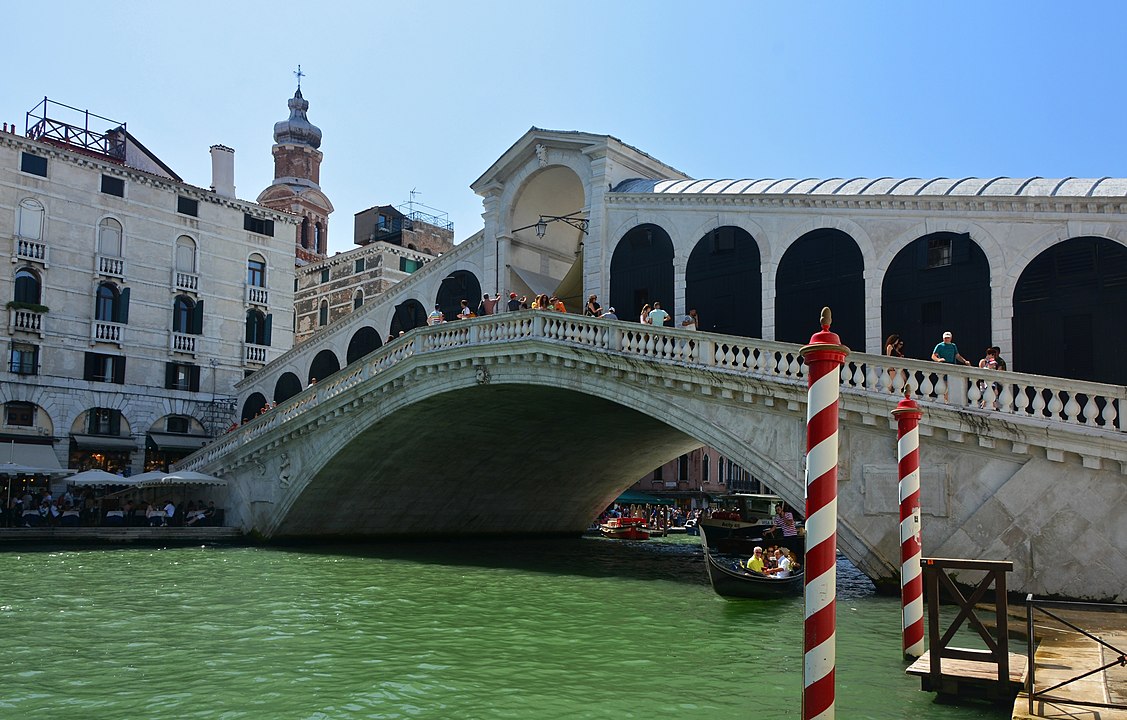
The last time I saw my grandmother (Gram, we called her) was at the nursing home. I had recently come back from my first trip to Italy (1985, I think). She didn't seem to recognize me but I had a stack of postcards and was showing them to her. When we got to a picture of the Rialto Bridge in Venice, she spoke of her father's stories of his "grand tour" to Europe in 1902. He had accompanied the art historian and professor O.P. Fairfield on the trip after an unusually hard year's work as acting president of Alfred University. His doctor said that the trip would do him more good than a year's medicine. This is paraphrased from the diary he kept on the trip.

My postcard of a famous bridge had penetrated my grandmother's aged fog and brought her memories of her father as it brought me a connection to the generations of my family. And confirmation of why I still love travel in general, Italy in particular, postcards, and probably even Palladio.

By Veronika.szappanos - Own work, CC BY-SA 4.0,
https://commons.wikimedia.org/w/index.php?curid=100527291

Some years later, in 2004, 102 years after my great grandfather's trip to Italy, I traveled to Venice with Sharon Chickanzeff, livening up my life narrative by breaking my arm at about midnight, with water on the plaza, under a full moon, while peering across the canal at Santa Maria della Salute.

14 November 2021

separated at birth: corner windows

Leesburg, Virginia -- posted in Historic Preservation Professionals group in Facebook by Kelly Whitton; comments included history of building: 1940s/1950s auto shop of some sort updated in the 1980s by architects Ballinger LaRock

Palermo -- Palazzo Alliata di Pietratagliata, second half, 15th century

06 October 2021

art with/by/for your neighbors

Two summers ago, Artist Michael Bernard Stevenson Jr and Cassandra Bull co-curated an exhibition in Alfred entitled "Won't You Be My Neighbor?" in which an artist and a community member developed a collaborative work which involved the eventual audience also collaborating. Sam Horowitz and I developed a piece that we called "Time Becomes Us" based on our preparatory conversations. Sam built a wood trough in which we placed layers of natural and artificial materials.

Our object was on display in Cohen Gallery at Alfred University along with the works by other collaborators. Folks were invited to add layers to the initial ones Sam and I had done. We provided a few buckets of clay along with rocks and other objects we found. Some rocks, asphalt chunks, and bricks were collected from the Canacadea Creek behind my house. The Cohen show was up for part of August into the school term. After the show, Sam removed the trough and fired the contents. He's done plenty of experimenting with firing rocks, particularly the shales from this region.

This summer, we took some of the fired detritus of the piece and put it back in the creek bed behind my house.

This afternoon, I came across a video from the American Academy in Rome about their recent Streetscapes series of installations. The works were done by Academy Fellows, partly in response to the pandemic and the desire to have works that could be viewed from the sidewalks around the Academy. The director talks in the video about making the Academy more visible to its neighbors. One of the works -- Novissimo Landscape Goes Silver by Francesca Berni -- looks rather like it might have been mounted in the garden of the Villa Aurelia (one of the buildings of the Academy). Bill and I were lucky enough to stay in the Villa Aurelia when I was in Rome to do NACO training at the Academy.
This is a screenshot from the video. The material looks like soft aluminum foil and makes a fine crinkly noise as it waves in the breeze. How nice it would be to be in Rome and see the installations.

07 September 2021

Lady Hamilton

 Maybe you had to be there. Matthew had his nineteenth-century dinner one evening in the mid-late 1970s in Pittsburgh. There were a couple dozen of us: grad students in art history, librarians, professors. The table stretched through the double doors between his living room and dining room. Several courses were served. I was costumed as Thomas Eakins. I don't remember who Dorothy dressed as. Julie came as Lady Hamilton, in a gauzy confection of white fabric. I so enjoyed meeting Lady Hamilton.

"In Rome I was glad to study: here [in Naples] I want only to live, forgetting myself and the world, and it is a strange experience for me to be in a society where everyone does nothing but enjoy himself. Sir William Hamilton, who is still living here as English ambassador, has now, after many years of devotion to the arts and the study of nature, found the acme of these delights in the person of an English girl of twenty with a beautiful face and a perfect figure. He has had a Greek costume made for her which becomes her extremely. Dressed in this, she lets down her hair and, with a few shawls, gives so much variety to her poses, gestures, expressions, etc., that the spectator can hardly believe his eyes. He sees what thousands of artists would have liked to express realized before him in movements and surprising transformations -- standing, kneeling, sitting, reclining, serious, sad, playful, ecstatic, contrite, alluring, threatening, anxious, one pose follows another without a break. She knows how to arrange the folds of her veil to match each mood, and has a hundred ways of turning it into a head-dress. The old knight idolizes her and is enthusiastic about everything she does. In her, he has found all the antiquities, all the profiles of Sicilian coins, even the Apollo Belvedere. This much is certain: as a performance it's like nothing you ever saw before in your life. We have already enjoyed it on two evenings. This morning Tischbein is painting her portrait." (J.W. von Goethe, Italian Journey, translated by W.H. Auden and Elizabeth Mayer, Penguin classics, 1970, page 208)

When I first read this paragraph an hour or so ago, I was smitten by the memory of the Pittsburgh dinner and Julie as Lady Hamilton. As I type it, the description of the tableaux vivants sounds rather like inappropriate behavior by older white men. Last night's group discussion was on "The new Puritans" from the October issue of The Atlantic. Maybe it's time to re-read The volcano lover by Susan Sontag.

15 February 2021

armchair traveler: Venice to Palmanova to Sabbioneta

 Mom used to travel vicariously with me. Now, we all can just about only travel vicariously when it comes to European destinations. I was writing up my Venetian adventure as a Pandemic Escape for the Alfred Sun and couldn't remember the name of the artist who did the painting of the Ospedale Civile in Venice that is at Yale now.

Walter Richard Sickert
L'Ospedale Civile 
Yale Center for British Art, Mellon Collection

As I was thinking about Venice, I went to flying over the city and zooming in on Google Maps. I had meandered to the northeast and noticed a name -- Palmanova -- that seemed familiar and probably telling. I zoomed in and there was the 16th century fortified city. Designed by Antonio Scamozzi (but that leads to a different story).


Thinking about Renaissance planned cities led me to think about Sabbioneta, over in Lombardy, north of Parma, where Christie and I stopped in 2001. 


09 November 2020

I Navigli di Milano, then and now

Two and a half years ago, we were in Milan, really enjoying the early evening cocktails and snacks, aka aperitivo. One of our most enjoyable evenings was along the Navigli (canals), on the south side of the centro. The remnants of the canals are there but it is now mostly social engagement territory rather than trade and warehouses. Last Sunday's Times had an article about the situation in Europe as coronavirus cases increase significantly. The article was accompanied by a photograph by Alessandro Grassani for the Times. He also has done significant series of photographs on immigrants and immigration. Now, the crowded streets of the Navigli are quite empty ...

A cyclist peddling down an empty street in Milan on the first day of a new lockdown on Friday.

(Alessandro Grassani for the New York Times)

06 September 2020

Italians and Jews in Odessa

Episode "Traveling to Eat" was on The Splendid Table on NPR as I drove home from Wegmans this morning. One of the stories was a talk with Caroline Eden who has traveled around the Black Sea, investigating places and food. She did a couple road trips but visited Odessa and Istanbul as specific destinations. She considers Istanbul the most grand food place in the world.

Caroline Eden mentioned the significant evidence of Italian and Jewish food in Odessa. Though there were ancient and medieval settlements where Odessa now is, its modern origins date back to 1794 when Catherine the Great established the city and port on the shores of the Black Sea, now in the Ukraine. It was a free port from 1819 to 1858 and the fourth largest city in the Russian Empire, after Moscow, Saint Petersburg, and Warsaw. There were Italians among the planners and developers and a large Jewish community developed in the 19th century. The Italians were mostly a legacy of Genoese colonies in the Crimea in late medieval times.

I've never known a great deal about Odessa though we did hear about it when Atticus Aldridge was explaining his origins to Rose and the Jewish refugees in York.

Atticus mentions to one of the refugees that his family came to England from Odessa in 1859 and 1871. The former nobleman says that he's not Russian, he's Jewish. There were several pogroms in the mid-later 19th century, including 1859 and 1871.

I hadn't known much about Genoa beyond art history classes until visiting it twice in 2018. I really enjoyed the city. The landscape is tremendous, the hills rise sharply from the harbor. The food is delicious. The art nouveau villas are stupendous, as they are all across Italy. Italians call art nouveau Liberty, from the store in London.


I probably don't need to mention how disappointing the pandemic-related travel restrictions are. It is soul numbing to not even feel that planning a European trip (or Canadian) is feasible.

21 May 2020

Italian post offices

One thing I have really enjoyed in Italian cities are the post office buildings. Good public architecture. Today's Docomomo Italia feed on Facebook included this wonderful Palazzo delle Poste in Ostia Lido.
Palazzo delle Poste, Ostia Lido, 1933-1934
Designer: Angiolo Mazzoni del Grande (1894-1979)
(collezioni Casa dell'Architettura di Latina)

Our hotel in Ragusa was around the corner from the Poste and I have just discovered that it was also designed by Angiolo Mazzoni:
Palazzo delle Poste, Ragusa, Sicily
(photo from ragusaturismo.it website)

Our first B&B in Palermo was across the street from the Palazzo delle Poste. We had a small balcony in our room and could look up and down the Via Roma with the Poste as the centerpiece. I guess Angiolo Mazzoni was the post office architect as he is credited with Palermo too.

When Trump first started talking about infrastructure programs, I was glad to think of public money going to public works. It hasn't much happened and certainly not on post offices.

22 April 2020

separated at birth: Sebastien Borgia

Cesare Borgia
The Borgias (SHOWTIME, 2011-2013)

Sebastien Raine
Schitt's Creek (Pop TV, 2015-2020)

03 April 2020

Piazza Cordusio, then and now

There's a wonderful photostream on Flickr with historic photos of Milan: Milàn l'era inscì Urbanfile  I'm not sure exactly what the name means and am guessing that it may be a regional dialect rather than mainstream Italian.

This photo has the caption "Via e Piazza Cordusio 1915-20" on Flickr. Piazza Cordusio is normally a busy space near the Castello Sforzesco and the Cadorna train station which provides a nice alternative to the central station when you're coming in from Malpensa airport, home to all kinds of shopping adventures and good restaurants. Very busy. It must be strange to be in Cordusio (as the neighborhood is called) at the moment of the coronavirus lockdown.

When I was in Milan in September 2018, a commercial "palazzo" around the plaza (formerly a post office) had just opened as the first Starbucks Reserve Roastery in Italy.
Six or seven streets come into the square, trolleys pass through, people wait for buses, tourists snap photos ... in normal times. Good memories.

22 March 2020

hunker down? go on a cruise? tell stories in an Italian country villa?

At the end of my morning walk, Drew and Mary were walking down the other side of the street. Drew asked if I was hunkering down or on a cruise. He explained the latter by describing the student houses around town that seem to have taken on new life, at least on a warm day. Folks on the porch, laughing, carrying on. I'd noticed the increased activity around the houses too. There were nine cars parked at the house and a half just before the AU campus. The university is closing the dorms today so residents have been here to clear out their stuff, after spring break. I feel especially bad, in this regard, for the students that come from busy urban areas and live in perhaps small family apartments. I wish the university could have figured out a way to provide for social-distant housing for the rest of the term for students if they wanted to hunker down here in the country. Yes, I realize that dorms involve more than providing a bed, e.g., supervision, food, potential medical care and deeper isolation.

Decameron, by Giovanni Boccaccio
MS. Holkham misc. 49, fol. 5r
Miniature by Taddeo Crivelli, circa 1467
Bodleian Library, Oxford

Now, if an Italian villa seems a bit difficult at the moment, you might consider a visit to Holkham Hall, perhaps my favorite Palladian house in England. Better make that a virtual visit for the foreseeable future.

09 January 2020

Palermo Springs

Palermo viewed from Monreale
(my picture, spring 2013)

Palm Springs, California
(Daniel's picture, January 2020)

We both studied at the Claude Lorrain School of Landscape.

24 December 2019

everyday wonders

Yesterday, somehow, I happened upon a citation for Everyday wonders: Luigi Caccia Dominioni and Milano: the Corso Italia complex, the catalog for a show at the 2018 Venice Architecture Biennale. His name is most enjoyable to say and the buildings he designed are also pretty special. The catalog is particularly focused on the 1957-1961 mixed-use (commercial and residential) complex he designed on the Corso Italia in Milan. I stupidly missed it, or perhaps vaguely missed it, when I was walking up the Corso last year.

I didn't realize I was supposed to be looking across the Corso as I walked up to find the 1951-1956 mixed-use (offices and apartments) building designed by Luigi Moretti, a block or so further into the center of town.
Note that the Torre Velasca is peeking over the upturned roofline at the left. My t-shirt with the Torre Velasca is just another everyday wonder. Its caption is "Milano loves design."

All of this was coursing through my brain (and heart) as I walked the loop this morning and "everyday" reminded me of Vija Celmins who did many sculptures of ordinary objects, natural and manmade, in her early career. She shifted to drawings later and there is a retrospective on at the Met Breuer now. Ends soon; I'll probably miss it ... but I didn't miss this pencil at a 2010 show at the Brooklyn Museum of women in pop art.
It's about three feet long. She also did some wonderful painted bronze "stones" which are displayed with the original natural objects. I enjoyed the review by Cigdem Asatekin of the Celmins show, entitled "Vija Celmins: To Fix the Image in Memory at The Met Breuer." I don't know: does "fixing the image in memory" play well with "everyday wonders"? Sure, as long as you leave space for tomorrow's wonders.

16 September 2019

Paci column in Venice and at Jeu de Paume

Last night at work I was looking at the 2019 annual collectors issue of Art News (vol. 118, no. 3, fall 2019) and happened on a small picture of The Column by Adrian Paci at the Architecture Biennale in Venice in 2014:
(photo from Architectural Association webpage)
And that led me to Paci's 2013 film about making the column on the boat as the marble came over from China. From stone to art, from East to West, from the ancient world to contemporary fabrication and economics. Images of Maersk trucks delivering a stone column to the plazas outside the Jeu de Paume in Paris.